English
  简体中文
简体中文  한국어
한국어  Deutsch



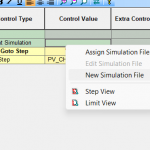
Test EV Battery pack with real-time drive condition using Simulation Control types
Information and Instructions for using the Simulation…


Information and Instructions for using the Simulation…

We are excited to share that Arbin will be participating in The Battery…
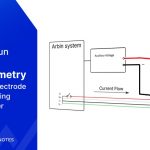
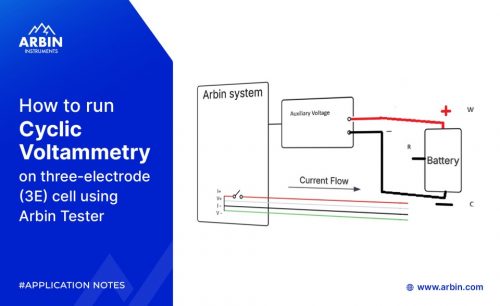
I. Introduction to 3E cell In a battery with 2 electrode…

Arbin Instruments was honored to participate…
Information and Instructions for using the Simulation control types. 1. General Description Simulation refers to the ability to input data collected from a non-formulated dynamic regime (i.e. other than Constant Current, Constant Voltage, Constant Power, Ramp, Staircase, Pulse, or Formula) as a control function. There are three control types: 1. Current Simulation – uses a […]
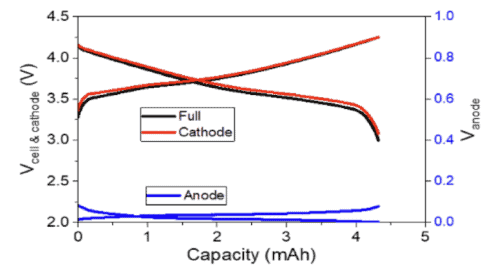
I. Introduction to 3E cell In a battery with 2 electrode, when you measure the battery voltage, you measure the potential difference between the cathode and anode of the battery. In this case, you only see the total difference in potentials and do not know how much each electrode contribute to this difference. You would […]
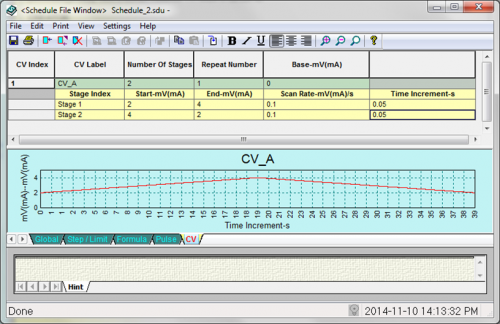
Arbin continues to power innovation in many areas of battery research, including electrochemical experiments such as cyclic voltammetry (CV). Arbin equipment is designed to perform electrochemical experiments with the precise circuitry required for linear voltage ramps, while the MITS software gives the user a wide variety of options to create test schedule profiles. Understanding the […]
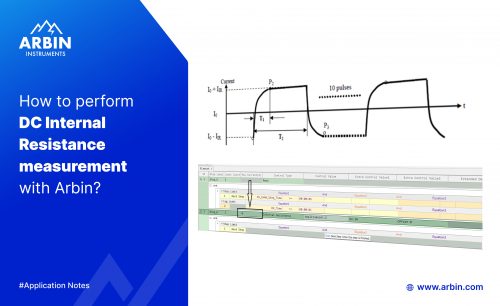
Mechanism explanations: Arbin’s MITS software uses pulse method to calculate IR. In order to achieve better accuracy, the software measures the IR 10 times and takes the average. The pulse looks like the graph bellow: IIR is the amplitude value T2 is the extra control value1 I0 is the offset value IR Calculation Formula: IR […]
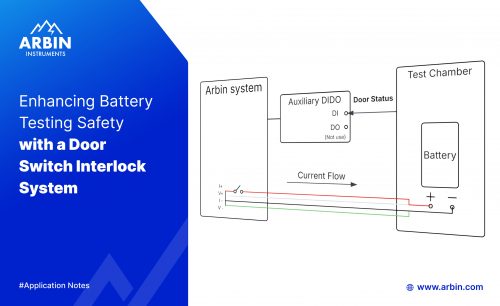
I. Purpose and Applicability Battery testing—whether for electric vehicles, consumer electronics, or industrial systems—demands strict safety protocols. One often overlooked but critical element in test chamber safety is the door switch interlock system. This simple yet powerful mechanism helps prevent injuries, equipment damage, and test data corruption. In this article, we’ll explore how door switch […]
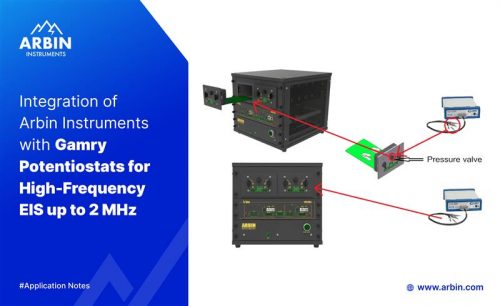
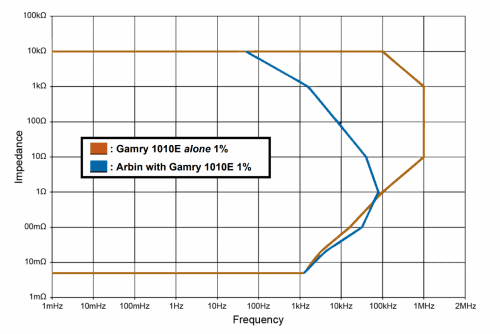
According to the standard specifications published by Arbin, integrating a Gamry device with an Arbin system typically limits the device’s original frequency capability from 2 MHz down to 100 kHz. However, in this article, we will introduce a solution that allows the system to retain the full 2 MHz frequency, with some trade-offs to consider. Pre-Conditions for Achieving […]
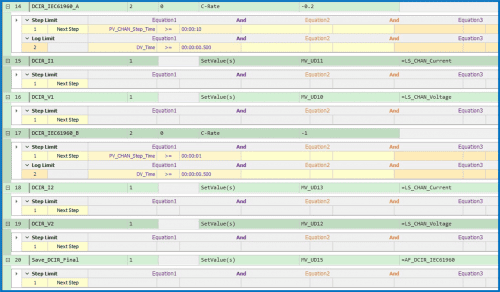
IR measurement is crucial to have an insight into a battery. There are many way, i.e. many standard to measure battery’s IR. This article will introduce IEC 61960 standard and how to implement it using Arbin’s equipments. IEC 61960 standard for battery IR: In this standard, a discharge pulse of 0.2C is given for 10 […]
Introduction Electrochemical Impedance Spectroscopy (EIS) is a foundational diagnostic technique for evaluating battery health, internal resistance, degradation mechanisms, and electrochemical behavior over time. However, EIS is traditionally limited by hardware complexity and high per-channel cost, making it difficult to scale across large battery test systems. To address these challenges, Arbin Instruments offers an integrated EIS […]
I. Purpose and Scope: The Protection Circuit Module (PCM) is a critical electronic component responsible for monitoring and protecting devices across a wide range of applications—from small consumer electronics to large-scale industrial equipment. Its core function is to ensure battery and device safety by preventing hazardous conditions such as overcharging, over-discharging, overcurrent, and short circuits […]
Introduction The Arbin Auxiliary Voltage Input Module enables precise, high-resolution voltage monitoring for battery testing applications that require measurements beyond the standard I/V channels. Typical use cases include monitoring individual cell or module voltages within a larger pack, measuring reference electrodes in three-electrode cells, or comparing BMS data with directly measured values. Each module supports […]
Introduction Battery temperature measurement is essential for evaluating safety, longevity, and performance in modern testing environments. Arbin supports three primary sensor technologies—thermocouples (Type T and K), RTDs (PT100), and thermistors (10kΩ)—each available through dedicated auxiliary input modules. These sensors enable precise temperature control, monitoring, and safety logic throughout battery R&D and production Description Battery testing […]
As we all know, the batteries’ capacity degrade by cycle of charge and discharge. If we set the charge and discharge current of a fixed value, such as 1A, 2A,… the length of each cycle will gradually decreases, simply because the battery’s capacity decreases: Cycle time = (Charge Capacity + Discharge Capacity)/Current Sometimes users want […]